


We explain the importance of a coherent design response to ensure your home is healthy, comfortable and efficient
Passivhaus principles
The Passivhaus standard has been around since the early 1990s. It has long been held that it consists of 5 principles; appropriate insulation, mitigation of thermal bridges, appropriately insulated and shaded windows, mechanical ventilation with heat recovery and airtight construction.
We delve a little into each one and also explain why they matter and why they need to be addressed cohesively; pick ‘n’ mix just won’t work!
Insulation
Insulation materials slow down the flow of heat from one place to another. That could be from inside your warm home to outside during winter or from a sweltering 40ºC day outside to your cooler home during a summer heat wave.
The primary role that insulation plays in a well designed home is to slow, and therefore reduce, this heat flow and thereby reduce the energy required to keep the building at a healthy and comfortable temperature inside.
Thermal Bridges
These are the physical pathways that conduct heat and coolth through the building envelope (the part of a building that separates the conditioned space inside from the outside world).
In a Passivhaus project, thermal bridges must be minimised and mitigated although not necessarily eliminated. The driver behind this principle is health. A thermal bridge creates a cold spot in the building where the warm, relatively moist internal air can make contact with the cold spot causing condensation to form which can lead to mould growth.
When we minimise a thermal bridge we are ensuring that the internal surface temperature of the building remains warm enough to prevent condensation forming.
Common thermal bridges in typical Australian homes include standard aluminium windows, uninsulated concrete slab edges, light gauge steel framing and steel beams that penetrate from outside to inside the thermal envelope. These are things we avoid in the design and construction of our buildings!
An unmitigated thermal bridge will negatively impact the insulation performance of the materials immediately surrounding it. For example, in a steel framed house the insulation will achieve about 50% of its rating due to the impact of the thermal bridging of the steel framing.
Windows and doors
These need to have good thermal properties to help reduce heat flow and be well sealed to avoid unwanted air infiltration.
They will always be double glazed as a minimum and in some climates triple glazing will be needed to ensure that the internal surface temperature remains warm enough. As with thermal bridges, a cool surface is a condensation risk. Windows also tend to be larger than most other thermal bridges so we need to consider the ‘radiative environment’. If the surfaces of a building are overly warmer or cooler than the internal air the human body experiences this as ‘radiant asymmetry’ (two different temperatures being projected onto the same body) which is uncomfortable.
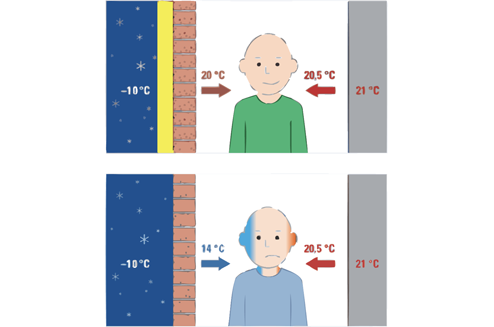
Any doors and windows also need to be appropriately shaded to balance heat gains in winter and summer. This can be done with eaves, blinds, shutters, almost anything that creates reliable shade. It is much more effective when this is done on the outside of the window. Internal blinds do help but the heat is already inside the building so the battle is partly lost.
Mechanical Ventilation with Heat Recovery (MVHR)
These are the lungs of the building. These units supply 100% outdoor air, 24/7 into the ‘dry’ spaces of a home (living rooms, bedrooms, studies, anywhere people spend time) while also removing moist air from the ‘wet’ spaces (bathrooms, kitchens, laundries). This continual air flow ensures that the internal moisture is removed from the building, ensuring condensation and mould do not form.
The volume of air exchanged is relatively low, approximately one third of the building volume per hour, ~200m3 in an ‘average’ Australian home. This is 3-4 times less than a single wall mounted air conditioner blasts out, the idea with MVHR is that you do not feel the air movement; in winter that would be experienced as cooling.
The MVHR has a heat recovery component which ensures that as the ‘wet’ air is exhausted from the home, its warmth is transferred to the incoming air. This heat recovery is the difference between incoming air at ~18ºC rather than an open window at 0ºC or whatever your outdoor temperature is at that moment.
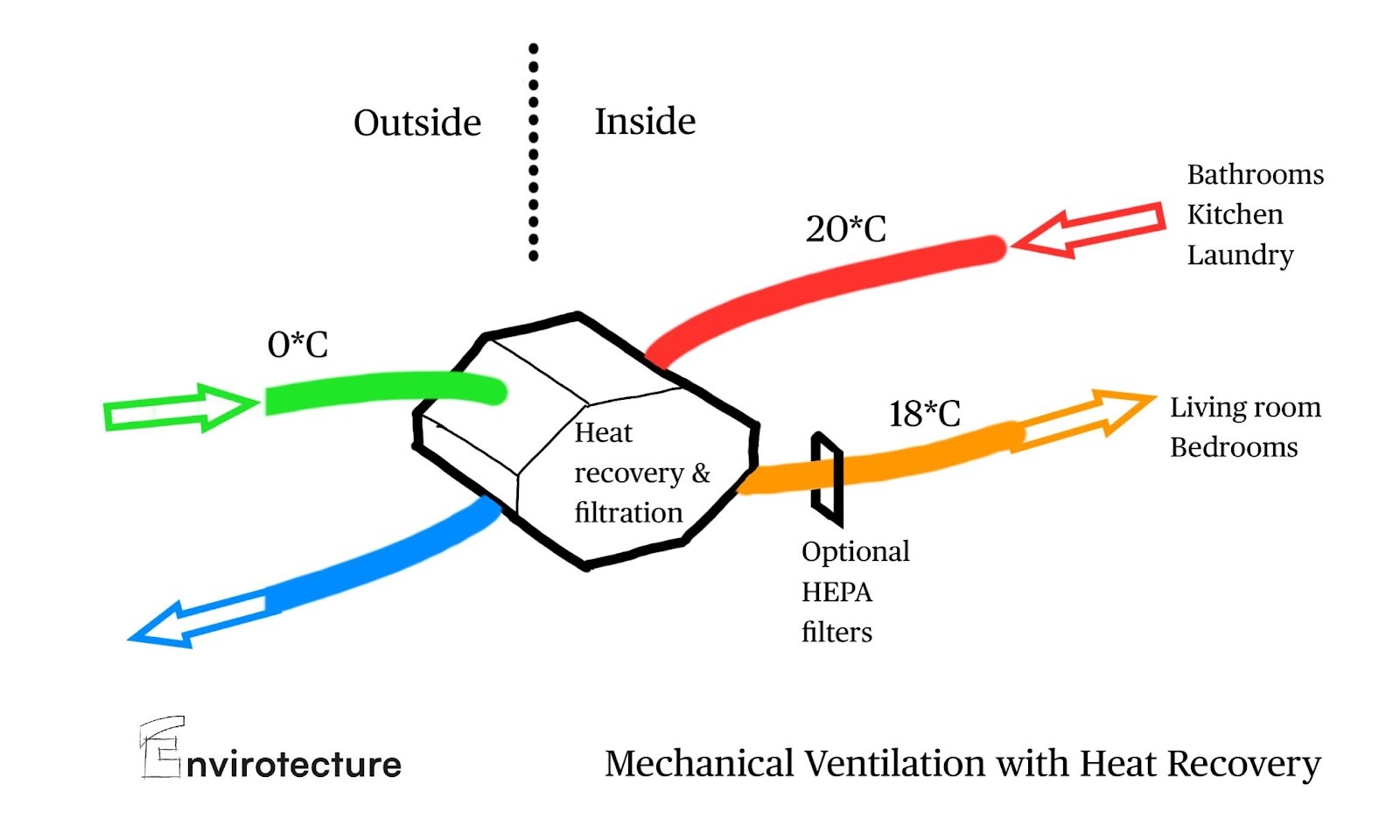
The MVHR also contains filters to remove outdoor pollution including pollen and larger particulate matter. In recent years, we have been adding a second layer of filtration for use only during bushfire events, the HEPA grade filters remove much smaller particles from air although they do not remove the odours.
Air Tightness
This is critical to an appropriate performing home as all of the measures listed above become fairly pointless if your building leaks like a sieve; check this video out of our cheeky explanation of this.
Air tightness is about having control over your internal environment so you can ensure you don’t lose or gain heat in ways that decrease comfort. It helps to reduce energy consumption as there is no need to re-condition the air. The Passivhaus standard for a new build requires a result of no more than 0.6ACH50 (air changes per hour measured at 50 Pascals of pressure difference), this is slightly looser for a retrofit at 1ACH50. To put this into perspective, a CSIRO study found a typical two storey Australian home is around 8.5ACH50, meaning in an ‘average’ home 5,100m3 of air per hour leaks through a home at 50Pascals of pressure difference which is the equivalent to a 33km/h wind, not that windy!
However air tightness does not mean no fresh air, this is why the ventilation system (MVHR) is a critical part of the home.
Living in an air tight home does not mean living with the doors and windows closed all the time, although you could, and probably will at certain times of the year. Air tight buildings allow you to have great indoor air quality with outdoor, filtered air 24/7 without necessarily paying the energy, or noise, or pollution penalty of an open window.
If you want to open doors and windows, you should. The MVHR will continue to do its thing, it is not impacted by the open doors and windows and turning it off saves so little energy (equivalent to half a halogen lightbulb) it is not worth the human energy! It can be the best of both worlds; naturally ventilated AND reliably ventilated.
Why not Pick ‘n’ Mix?
Unlike some building certification schemes that are ‘points’ based, Passivhaus is a holistic approach to deliver healthy and comfortable homes. The principles listed above are all critical to a building performing well.
To make an airtight building but not provide reliable ventilation will lead to mould growth.
To insulate but have gaps around doors and windows, will leak heat causing drafts and excess energy use.
To install triple-glazed windows, but ignore appropriate insulation and airtightness can still leave your home cold.
To ignore appropriate shading will, in almost every climate, cause summer overheating.
To be honest, there is no negative impact to mitigating thermal bridges and ignoring everything else although the results would be underwhelming.
Finally, the one principle you may act upon at the exclusion of others would be MVHR. It makes any building better by improving indoor air quality. The systems do work much more effectively in more air tight buildings, however my own 10ACH50 unrenovated home still benefits from outdoor filtered air 24/7; I wouldn’t live without it!
Eight Principles?
While we are strong advocates of passivhaus, these five principles on their own are not enough. There are three more, read on here…

Andy Marlow
,
Company
Andy joined Dick Clarke at Envirotecture as a young architect, gaining significant experience in designing genuinely sustainable buildings, both residential and non-residential, in Australia and overseas. After a stint at a large corporate practice, Andy returned to Envirotecture as a director in 2014. He went on to found Passivhaus Design & Construct in 2020, in order to make Passivhaus performance more accessible for more people.
Discover our people (and what it's like to work here) and awards we've won.
Explore our expansive library of resources for people interested in sustainable, healthy homes.