


Why the 5 passivhaus principles are not enough and there are 3 “new” ones you need to be aware of.
(Eight) Passivhaus Principles
The Passivhaus standard has been around since the early 1990s. It has long been held that it consists of 5 principles; appropriate insulation, airtight construction, mitigation of thermal bridges, provision of reliable ventilation with heat recovery, and appropriate insulated and shaded windows. You can read more about them here.
While these physical aspects are undoubtedly key features of all Passivhaus projects and a main driver for the continued reliable performance of these healthy and comfortable buildings, there are other factors!
Within the Passivhaus community, we are now also talking about the 3 Principles of Approach in addition to the 5 Building Principles. The clear communication of these 3 ‘new’ principles is critical to understanding the value of the Passivhaus.
The three principles of approach are:
- Performance & comfort criteria
- Thermal modelling in PHPP
- Quality Assurance
It is these 3 Principles of Approach that have always distinguished a certified Passivhaus building from one that follows ‘Passivhaus principles’ or whatever words were used to describe, ‘we didn’t really do Passivhaus but just the bits that suited us’.
Performance and comfort criteria
The Passivhaus standard sets clear headline metrics for heating demand and load as well as cooling & dehumidification demand, airtightness, and ventilation. Comfort performance is set by both temperature (20-25ºC) and maximum indoor humidity (12g/kg). There are additional criteria less commonly known around noise and internal surface temperatures, both critical to a healthy and comfortable building.
These criteria have a strong scientific basis that, when paired with the newer certification classes around renewable energy production (Classic, Plus and Premium), deliver buildings that can be self-sufficient (Plus) or net energy exporters (Premium) over the year.
The criteria are globally applied meaning that regardless of location, the comfort and health outcomes as well as the energy used to maintain them should remain the same. This results in a building in Ballarat having more insulation that a building in Sydney, this contrasts with the Australian NatHERS system which allows the Ballarat building to use five times more heating/cooling energy than the Sydney one!
There is a variable allowance to deal with the energy for cooling and dehumidification which is acknowledgement that creating coolthand removing moisture from the air can be energy intensive and does not always have ‘free’ energy source alternative.
Thermal modelling in PHPP
The Passivhaus Planning Package (PHPP) is the thermal modelling tool used to predict the performance of a passivhaus project. It is highly detailed, factoring in geometry, orientation, climate, thermal envelope values and ventilation as do most other modelling tools.
Over and above the usual Australian tools, the PHPP also takes into account airtightness, thermal bridges, climate elevation and more detailed data on ventilation (both mechanical and natural); it actually asks how much a window can open rather than assume a window of a certain size admits a predefined amount of air regardless of sash type!
It is the level of detail within the PHPP that allows it to be an incredible design tool. This allows us to optimise the building to find the most cost effective way to meet the Passivhaus standard, something our clients enjoy!
It also allows us to answer the questions ‘how much better?’ whether it be changing a window size, adding more insulation. Most significantly, it gives us confidence that ‘poorly’ orientated sites (north in inconvenient locations) can still deliver great homes that are healthy, efficient and comfortable; this, this, and this project all have north to the street which, in passive solar design, is incredibly hard to resolve elegantly.
When comparing the predicted energy use against the real world performance, the PHPP has consistently shown to be the most accurate modelling tool. This is partly due to the tool but also due to the next Principle of Approach, quality assurance.
Quality Assurance
The Passivhaus certification system ensures that a passivhaus certifier has reviewed all of the documentation for a building, is confident that it has been built in accordance with those documents and also that the air tightness has been achieved.
They check the PHPP calculations against the documentation before construction begins to ensure the Passivhaus standard can be met; much better to find any errors on a screen than a building site! They check the works themselves are executed as documented and review air tightness test certificates as well as reports on the commissioning of ventilation systems.
This oversight by a third party can sometimes feel onerous, but as a team that has been through this many times, we value the third set of eyes, expertise and peace of mind we get from knowing that everything is as it should be. For our clients, it gives them comfort that we have done our jobs well.
The principle puzzle
Of the eight passivhaus principles described here and here it is safe to say they all matter equally if comfort, health and efficient buildings are your goal; they are all parts of the same puzzle with serious risks from cutting corners. For anyone wanting to dive deeper into the possible downsides this article from the wonderful UK Passivhaus Trust is a prescient lesson in how wrong things can go both physically and reputationally.
Andy Marlow
,
Company
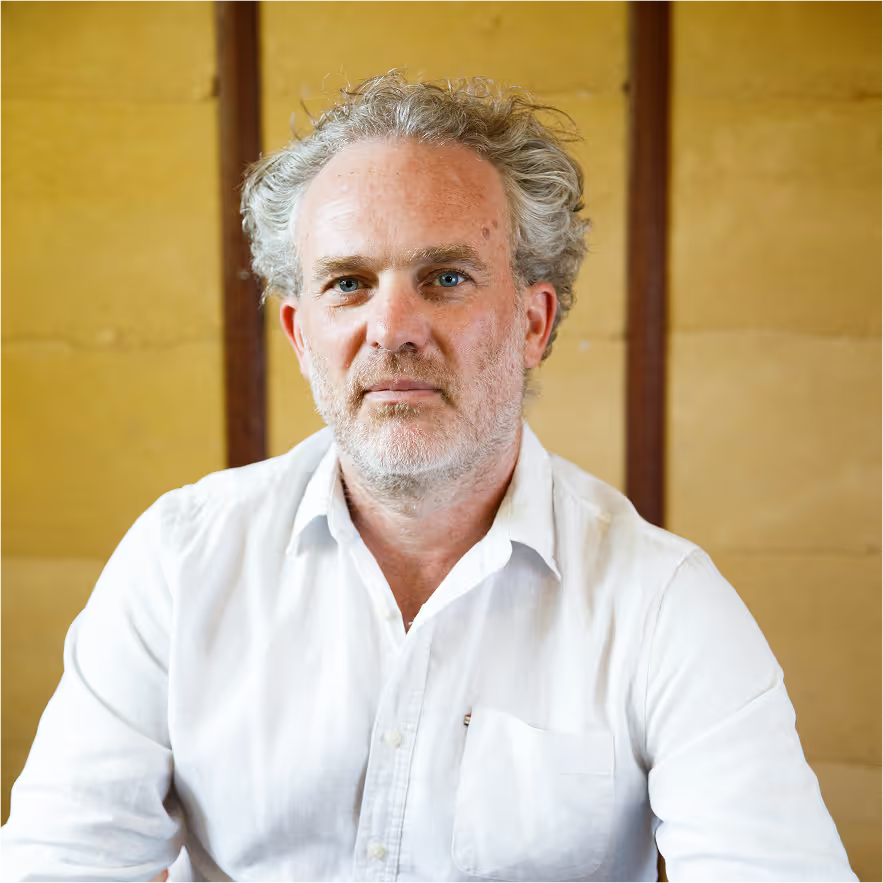
Andy joined Dick Clarke at Envirotecture as a young architect, gaining significant experience in designing genuinely sustainable buildings, both residential and non-residential, in Australia and overseas. After a stint at a large corporate practice, Andy returned to Envirotecture as a director in 2014. He went on to found Passivhaus Design & Construct in 2020, in order to make Passivhaus performance more accessible for more people.
Discover our people (and what it's like to work here) and awards we've won.
Explore our expansive library of resources for people interested in sustainable, healthy homes.